Reward system
We live in an era of unprecedented awareness about dopamine and the reward system, and unprecedented difficulty controlling it. This is the G.I. Joe fallacy in action: knowing is not half the battle. Here is another attempt to close that gap.
The reward system motivates us to take actions that lead to beneficial outcomes while avoiding detrimental situations. Over time, it helps us learn and reinforce behaviours, playing a central role in shaping our behavioural model. Most of our repetitive habits and behaviour are driven by the reward system. Most of the living beings, especially those that can move, find food, and sexually reproduce, have this system.
Rewards
Evolutionary (primary): These reward functions are shaped by evolution and are directly related to survival and reproduction: social stimuli (bonding, recognition, competition), safety, sexual behaviour, and eating food.
Learned (secondary): Secondary or learned habits are built on top of primary reward functions. Examples include making money, social media engagement, video games, or professional achievement. These activities trigger the reward system because they simulate or indirectly provide access to primary rewards such as social recognition, status, and resources.
Penalties
Penalties include signals that discourage certain behaviours: physical pain, emotional distress, social rejection, or social pressure. e.g., use of punishments by law enforcement, emergent social response to behaviour outside social norms.
From the above examples, it also becomes clear that emotions are tightly coupled with the reward system.
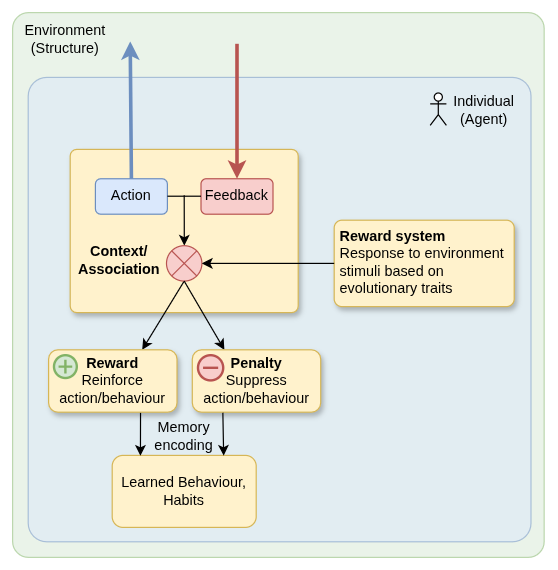
Role in building a behavioural model
The reward system is a crucial factor in children’s behavioural development and their ability to lead a functionally healthy life. Early childhood behaviour is largely driven by exploration of the environment. At early stages, children cannot distinguish what is safe or unsafe, e.g., what should not be put in their mouths. Still, parents repeatedly saying NOO with wide eyes serves as negative feedback associated with the action. They eventually stop doing it, while positive feedback, such as praise for good grades, reinforces associated behaviour. It’s crucial that positive acknowledgements/compliments and negative acknowledgements/penalties are delivered with high accuracy by the environment for respective actions or behaviour. In a sense, the environmental feedback acts as a training dataset. Accurate feedback serves as correctly labelled data, helping children associate actions with outcomes. This aligns with reinforcement learning principles, where behaviour is shaped by repeated reward and punishment signals.
While human behaviour or brain stats such as emotional valence are difficult to measure precisely across individuals and environments, we can approximate them using coarse categories (quantisation), for example, classifying actions as low, medium, or high in terms of desirability, and pairing them with corresponding levels of reward or punishment. (The diagram below shows such a pairing).
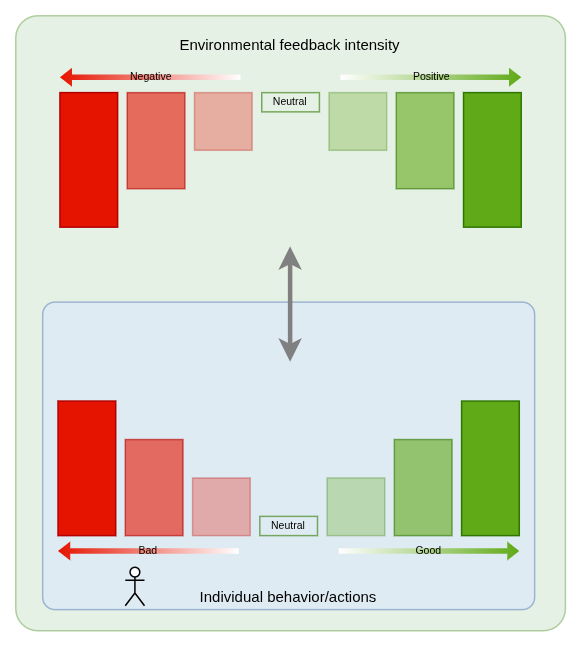
It also has to be paired with reasoning to build a comprehensive understanding, avoid blind adherence to constraints, and achieve better self-supervised learning.
Individual x Environment
At any point in time, the behavioural model of an individual is a product of continuous interaction between the actions of that individual and the environment. In other words, the environment is responsible for a significant portion of the behavioural development of inhabitants. Considering this, how social systems reward or penalise their inhabitants is extremely important in shaping collective social behaviour.
This also includes indirect feedback learning, such as what behaviour of others leads to rewards and penalties. We have a tendency to reproduce the high-reward behaviour and suppress penalising behaviour of others, e.g. viral short-form content remakes, fashion trends, etc. The effect of this influence is much higher from celebrities and other highly visible personalities (high rank nodes), as their behaviour reaches a much larger portion of the network.
Behaviour is not formed by intention alone, but by the consistency and accuracy of feedback received from the environment.
The mind behaves like a statistical model in many ways. Our behavioural model (behaviours and habits) is built from countless pieces of feedback received since birth. A non-negligible amount of mismatch between behaviour and environmental feedback at an early age creates a malformed foundational model that distorts subsequent perceptions, trapping the individual in a vicious cycle. Depending on severity and the combination type of mismatch between behaviour and environmental feedback can lead to a fragmented cognitive model, malformed emotional response, over/under confidence, and polarised behavioural patterns.
Figure tip: visualisation column: Black: actions/behavioural distribution(right side-positive actions, left side-negative actions), Blue+red: Environmental feedback and its imprinted emotional response function. Blue: rewards, Red: penalties.
Action-feedback mismatch types and its effects
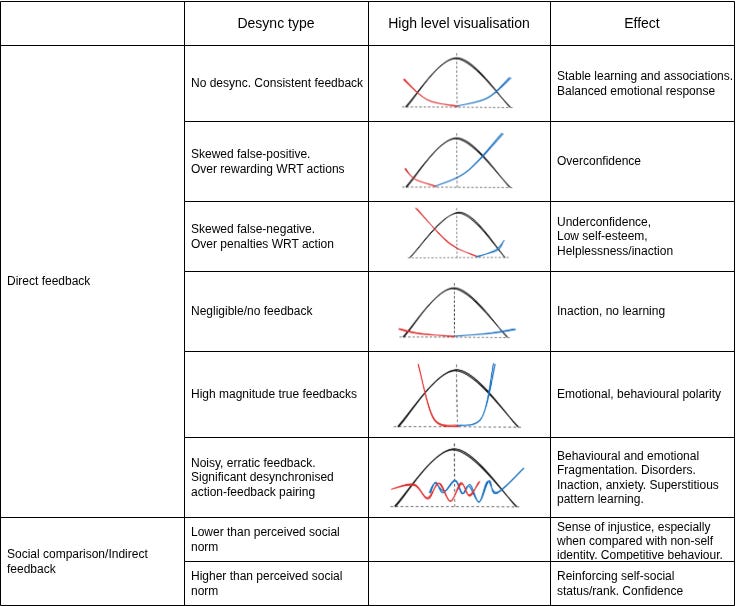
Reward signals are powerful enough to reinforce habits despite conscious awareness of their contradiction, creating behavioural patterns that are inconsistent.
Similar to a belief system, the action-feedback sync does not necessarily need to be backed by empirical truths, but importantly, social truths, allowing social navigation with minimum conflict and cognitive dissonance (considering the aim is not to be right but to be accepted and safe).
Reward normalising (Hedonic adaptation)
While we are living our day-to-day life, each of us adapts to a certain level of rewards. Over time, repeated exposure to rewarding activities raises this baseline. Activities that once felt highly rewarding begin to feel normal. To experience the same level of satisfaction again, the activity must occur more frequently or with greater intensity, gradually raising the subjective baseline. We burnout, get depressed (not clinical), and anxious when activity engagement is reduced or becomes impractical.
In concise terms, an individual’s subjective level of normal/baseline, which can be expressed as the average of all rewards associated with actions over a specific time window. We have a tendency to continue meeting this level of expected reward or increase it through actions. Actions/behaviour that exceeds these expected rewards will be motivating, and while falling short will be depressing (not clinical depression).
This is why people face difficulties reducing social media, gaming time, etc. after prolonged intense engagement. This is why practices such as meditation, intentional boredom or reduced stimulation can help reset the baseline and restore balance in reward-driven behaviour.
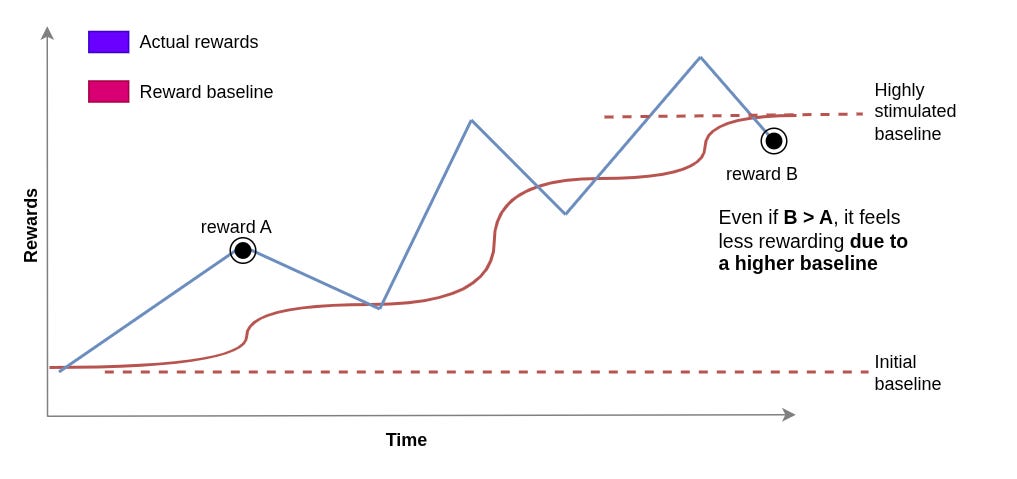
The reward system is evolved to build or reinforce behaviours to acquire the resources necessary for survival. However, because it responds automatically to environmental stimuli, it is highly susceptible to exploitation. In modern socio-technical systems, many mechanisms are intentionally designed to capture and manipulate this system. What we interpret as free will in our behaviour may largely emerge from interactions between the individual and the environment. At present, there is no clear boundary separating ethical engagement from exploitation. Along with identity, the reward system is a highly utilised component in economic, PsyOps/cognitive warfare.