Identity
- Single most important evolutionary behaviour from social stability POV.
- Identity consists of the:
- The “two traits”:
- Group affiliation
(Social identity theory) - Territorial association.
- Group affiliation
- Individuality / individual role WRT two traits.
- The “two traits”:
- Evolutionarily, and even in present-time tribal settings, the two traits are near-compulsory mutually inclusive.
- Economic, trading activities between identities ease up two traits. Conversely, resource scarcity / high economic stress intensifies identity and biological competition. This identity-economy seesaw effect can be used to form an integrated, sustainable network of regions/identities.
- In modern times, the current implementation of the nation-state-culture system induces a sense of identity with decoupled “two traits” without safeguards against identity exploitation of large populations.
- Identity is constantly exploited through political/economic/violent means worldwide (inter-national, intra-national).
- Examples of variables across which identity can be leveraged or exploited:
- Territorial provocations: Challenging territorial/boundaries status quo, territory partitioning/border redrawing to create new disputes.
- Non-territorial identity variables: countries/states, communities, sub-communities, ideologies (left, right, capitalism, communism), physical attributes (various skin, hair colours, mono-lid eyes), religions, ethnicities, languages, gender/sexual orientations and recently trending generations (millennial, Gen Z, etc.)
- On the positive side, Achievements are celebrated in identity crossovers such as sport victories, technological, scientific advancements etc.
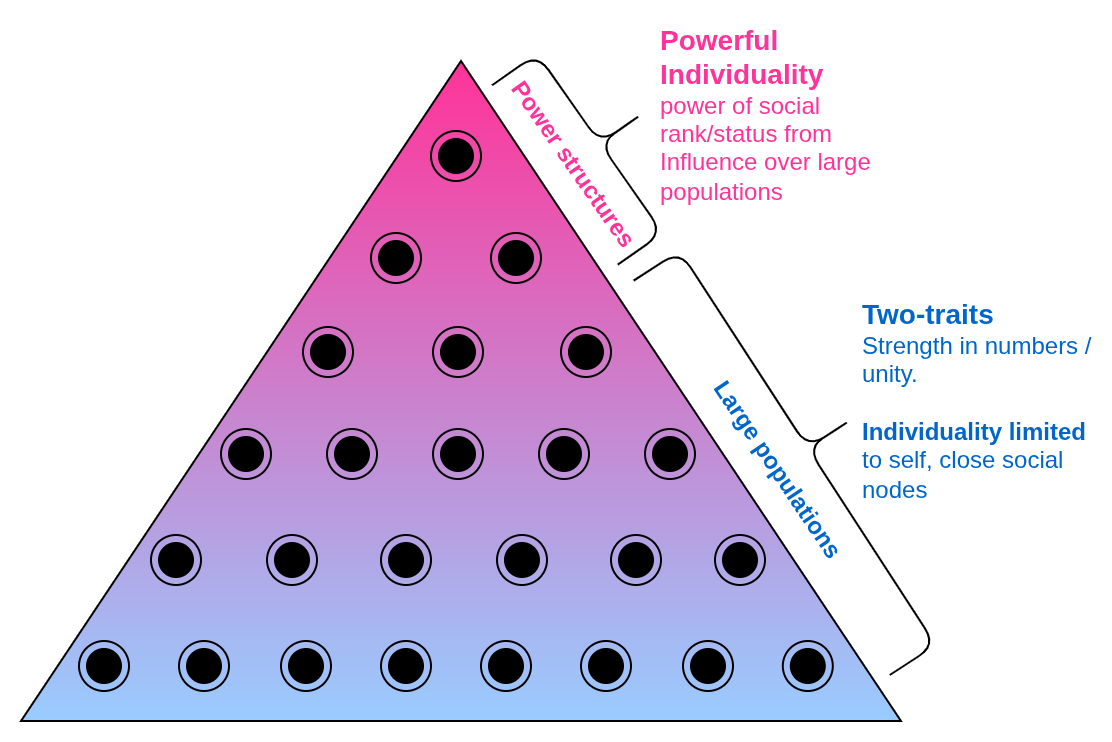
- Balanced incorporation of the two-traits and individuality can promote social responsibility and prevent reward-maximising behaviour among individuals. Tradeoff between individuality and two-traits is observable in social hierarchy. Individual identity/role is powerful and influential from high rank nodes / personalities POV whereas strength of large populations comes from being in cohesion through two-traits.
Identity tradeoff
Identity crisis
- Any observed/perceived information or experiences, especially ina non-negligible quantity and a relevant time span that is contradictory/not aligned to existing identity beliefs, leads to an identity crisis.
- The two-trait model collapses. When we say collapse, it’s not the two traits themselves but the values it holds.
- Unlike sudden mental injury/trauma, an identity crisis gradually affects overall behaviour, destabilizing primary cognitive model.
- Since identity is a core value for normal human functioning The mind triggers a mechanism in order to rebuild the identity cognitive model.
- Due to the injured mental state, years of existing pieces of information/memories are in a dangling state. Information gushing in from the environment is not efficiently and accurately analysed, labelled, and assigned importance weights, causing cognitive overload.
Behavioural traits of active identity crisis
- Increased sensitivity to overall environmental stimuli. Increased vulnerability to addictions, naturally selected high reward functions/stimuli, e.g. Sexual attraction/porn, social stimuli, food cravings. Increased emotional response, volatility, including impulsivity, mood polarity. Amplified cognitive dissonance.
- Discomfort in society, low confidence, mimicking the behaviour of others, normative social influence, pleasing behaviour.
- Unrestrained emotional and reward-driven thinking/behaviour. In order to rebuild the cognitive model, going through existing memories/data, trying to find patterns and possibilities leading to daydreaming, self-talk, manifesting as hallucination.
- Hyperactivity (I believe, hyperactivity/short attention leads to necessary stochasticity (randomness) and exploratory behaviour while information gathering, going through existing memories/data (retraining) to avoid forming biased cognitive model)
- Various dualities add up to cognitive dissonance:
- Heightened sexual attraction/pair-bonding drive but reluctancy forming relations due to state of crisis and absence of social, territorial safety.
- Modern social design out of sync with evolutionary two-traits.
About recovery,
- Extreme information-dense modern environment is the cause behind susceptibility to identity crisis, as well as the obstacle for recovery. Due to the same,the victim is prone to identity foreclosure.
- Most of these problems occur when deprived of aid and true feedback from the environment/society.
- A natural way to recover is allowance of engagement in meaningful activities socially, culturally, and economically, which acts as true-positive feedback/rewards for the mind to rebuild cognitive model.
- Because of the higher sensitivity to environmental stimuli, an active identity crisis (identity moratorium) is a highly valued mental state from PsyOps POV. Applications at the individual and population scale. The use of this knowledge for psychological, socio-economic warfare is not acknowledged widely, nor do safeguards exist in society. Unlike traditional physical warfare, these attacks are relatively difficult to predict, identify and confirm.