Imagine you and a cat are inside a two-storey house. A house is a physical structure; you and the cat are agents in the structure. Agents have a certain agency, which is the capacity to perceive options and perform actions within a structure. e.g. Actions you could perform are: play loud music, play with a ball, use the staircase to go up, etc. There are physical constraints; you cannot go through walls or enter the 2nd floor from outside. But the cat may be able to enter the 2nd floor from a nearby tree or roof, but may not be able to open doors. Same structure but two agents with different agency (capabilities).
The Structure Within
Now, you have parents at home and may not be able to play loud music or play with a ball. Same physical constraints, but now there are social constraints. Such constraints form the abstract structure. can’t see or touch it, but real nonetheless.
Our mind maintains a world model. This internal model is a subjective version and a small subset of the actual world. e.g. Before travelling to a destination, you’ll come up with possible routes from your current location, modes of transport, etc. Your decision-making will be limited to the information you already have and any map service provider. There exists a most optimised route, but you will not be able to utilise it if that information is absent from your mind or the map service provider. The world model is not just of physical terrain but also of abstract structures. Our actions within the environment, in any given circumstance, are decided based on this internal world model. Most of the time, we almost behave in an automated manner.
In the previous home example, the individual refrained from playing loud music in the presence of others to avoid argument/conflict.
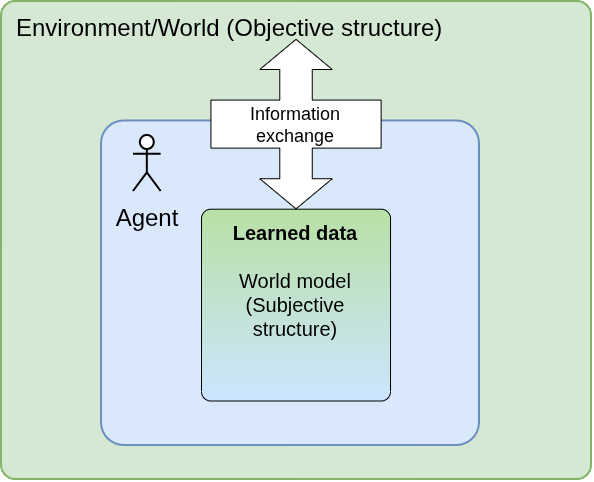
In a specific context, error through environmental feedback or observation motivates us to update either the internal structure or the external structure. This helps maintain a consistent subjective model for better navigation. Read more about error management and cognitive dissonance in this article. In many cases, the agent and the structure co-evolve, e.g. beavers—dams, humans—social systems, where we don’t just adhere to learned structures but also change them.
Evolutionary traits serve as the underlying foundation to our behaviour/agency, but many abstract structures are learned after we are born. e.g Humans, a single species but raised in various social systems, form different behavioural norms. Specific activities may be legal, rewarded in some social systems and restricted in others.
Animals’ evolutionary cognitive models are products of gradual training over millions of iterations/lifetimes, random mutation and novel behavioural patterns. The ones which led to survival and reproduction were inherited. All the diversity of beings we see today has evolved from much simpler organisms that became more and more specialised to specific arrangements of structure. e.g. beings with abilities (behavioural and physical) to thrive in e.g. rain forest, desert, water bodies, etc. You can observe that the territorial sense is very common among animals since that structure provided a foundation for agency throughout the evolution of all species.
Currently, the agency is only observable in living beings. And, AI systems, if we include man-made entities. Asteroids, planets, atomic particles, elements, weather systems, etc., have no agency but are governed by laws of physics, such as acting forces, chemical reactions, etc.
Agents are not necessarily individual beings like humans. In contexts such as geopolitics and conflict, we can consider organisations as agents.
Degree of Agency
The question of whether something is agentic or not is much easier than evaluating degree of agency. Some agents exert more agency than others.
e.g. Coordinated groups are likely to have more agency than individuals. Individuals with highly accurate subjective structure are likely to make more correct decisions but must have resources to act (exert agency).
System variables
- Agent
- Subjective structure accuracy.
- Human bias awareness (evolutionary+learned)
- Structure
- Constraint
- Physical
- Abstract (Social rules, norms etc.)
- Other agents
- Reinforcing, balancing, neutral.
- Constraint
Know more about Super Structure.
Reward Seeking
Repeated ancestral behaviour that promoted survival and reproduction is registered as a rewarding evolutionary trait in subsequent iterations. All of our fundamental rewarding activities, such as socialising, pair bonding, etc., are products of such natural selection and hence drive our behaviour. Most of the things we do are to achieve these rewards. Read more about the reward system and its importance concerning human behaviour in this article.
Game Theory
Game theory is the study of such agents with co-dependent decision-making within a specific system. The existence of multiple independent agents makes the system highly dynamic.
Here are a few links related to Game theory:
article by The forbidden files. YouTube: